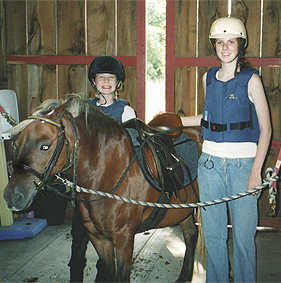
Grooming and tacking
Photo Credit: Carol Rae Hansen, 2008 All rights reserved
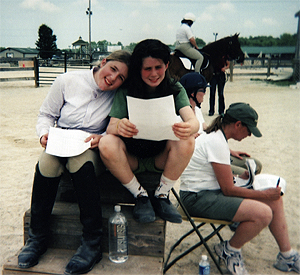
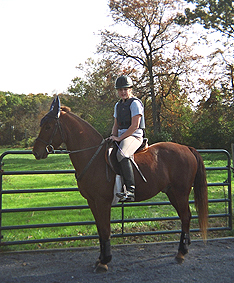
Best Friends
Photo Credit: Carolyn Ewels, 2008 All rights reserved
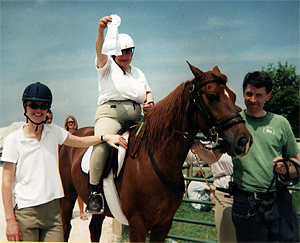
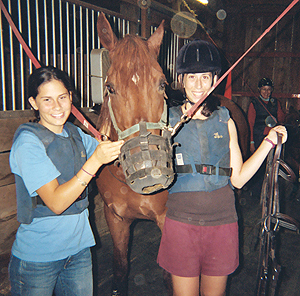
Sidewalking for safety
Photo Credit: Carolyn Ewels, 2008 All rights reserved
VOLUNTEERS AND APPRENTICES ARE
ALWAYS WELCOME
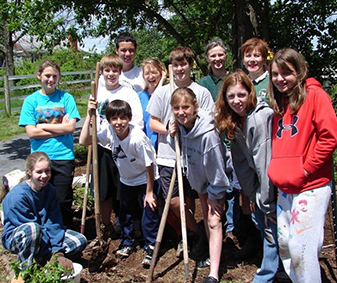
ETA warmly encourages teens and adults to volunteer individually or in groups. ETA hosts badge workshops for Boy and Girl Scouts, community service volunteer school assignments, and equine assisted education. See more photos of our 12 wonderful Norwood School volunteers on "Our Methods and Facilities" and "Photo Gallery" pages.
Click here for Volunteer Job Descriptions
Volunteer Opportunities
ETA accepts volunteer applications all year around, and schedules at least
four free three-hour training sessions for volunteers. Please check our ANNUAL
CALENDAR for the next training session. Each volunteer is asked to take NARHA's, PATH Int'l's
free on-line training course for Volunteers before attending the
Carol Rae Hansen, 2008, All Rights Reserved
farm session. A take-home booklet is provided upon the completion of the farm session,
which can be studied in greater detail at your leisure. A two-session practicum
completes the nine-ten hour period of formal instruction, usually during the
first two times that the Volunteer comes to the farm to work with individual
students. A certification of completion is provided, and each new volunteer
has the option of taking ETA's 10-week summer lecture series as well for free. Volunteers are always
welcome as side walkers, grooms, stall and tack cleaners, exercise riders,
show ring assistants, and ring stewards. We also often need volunteers to
work on special projects at the farm, such as painting, assisting at shows,
building jumps and equipment, and refurbishing equipment. Our Pre-Driving and Pre-Vaulting programs
always need volunteers, as well. Of course, our volunteers always love to work with Special Olympics riders,
as well as with our Challenged Rider Show Teams. Community service credit hours are given. If you think that you have the skills, motivation, desire and
interest to succeed as an equine volunteer, please apply here online. Thanks!
PATH Instructor Mentoring
ETA warmly welcomes you to consider training to be part of ETA's certified PATH Int'l. Instructor Team! The length of time needed and the terms of the relationship will be determined by your level of expertise and your previous training in riding, horsemanship, disabilities, and teaching ability. The goal of our mentoring program is to help you hone your skills and build your knowledge base so that you can become a certified PATH Int'l. Instructor, and to help you launch your new professional career! Please contact us for more information. Thank you!
Three (3) Apprentice Opportunities
The following may help you achieve the Instructor in Training status required
by NARHA, PATH Int'l., in terms of completing the required number of mentoring hours with
a NARHA, PATH Int'l., certified instructor.
Three month paid Apprenticeships
We offer three month apprenticeships in therapeutic riding, should that be
of interest to you, as well as short courses in the summer that take a week.
The apprenticeships pay a stipend to the student, and cover 12 key aspects
involved in directing a therapeutic riding program (one each week). Apprentices
are expected to read a book a week (we lend eight, but the apprentice is expected
to read and buy four, all required by NARHA, PATH Int'l.). Apprentices actively learn stable
management, pasture management, first aid for horses, customer relations,
equine theory, horse psychology, and so forth. These apprentices actually
do the work of a program manager, from stall cleaning, to evaluating a student
for lessons, to writing lesson plans, to preparing for a Challenged Rider
horse show. If the apprentice succeeds in the program, and if she/he wishes
to apply for NARHA's , PATH Int'l.'s instructor certification program, ETA will sponsor that
apprentice and assist in the process. Apprentices work a full day, five days
a week, for three months, and their stipend depends upon previous experience
and training.
The Six Day Short Course
The six day short-course of exposure to therapeutic riding costs $1,000. It
is intended for professionals who wish practical experience in conjunction
with their application to NARHA, PATH Int'l., for an instructorship, or it augments the
therapy background of a professional who does not intend to apply for instructor
certification but wishes to learn considerably more about TR before working
with a TR program. It is not intended to take the place of a NARHA, PATH Int'l., instructor
certification course, but it does offer the 12 formal areas of instruction
noted above, but in a much shortened version (two a day). Four books are read
before the student comes to ETA, and then 12 lectures and 12 sessions of practical
instruction are covered in the six days. This is a one-on-one seminar program
offered by Carol Rae Hansen, Ph.D., Director of Equine Therapy Associates.
We usually schedule two or three of these a year, one in the summer, and one
each in the spring and fall. They usually occur when ETA is not formally in
session, so that a minimum of distractions exist that might detract from the
intense seminar experience. Some hands-on work with disabled students does
occur, through the medium of students that lease our horses/ponies, trips
to therapeutic riding horse shows (where the short course apprentice serves
as a sidewalker), and through evaluations of potential clients (a two hour
experience).
The One Week to One Month Volunteer Option
The third option is a volunteer session organized through a school, when a
full exposure to therapeutic riding occurs. Each volunteer grooms and handles
at least two horses/ponies a day, rides or otherwise exercises those two horses/ponies,
cleans stalls, cleans tack, meets with clients, and learns to be a sidewalker
as well. Lesson planning is described, program design is explained, and exposure
to all of the elements of a therapy program is sandwiched in between lessons
and exercise periods. Community service credit hours are given.
Photo Credit: Carol Rae Hansen, 2008 All rights reserved |
Photo Credit: Carol Rae Hansen, 2014 All rights reserved |
Photo Credit: Carol Rae Hansen, 2008 All rights reserved |
How Do We Apply?
If any of these four options are of interest to you, e-mail the Director and
apply by downloading the application materials under the "Registration
Forms" button. Download the release of information
document (F15-04) [the F number is on the bottom right of the page]; the participants
application and health history (F13-04) and just mark N.A. for what does not
apply (this is also used for therapy students), the physician's release (F25-04),
and the Volunteer/Staff form and health history (F22-04), and circle "staff" or "volunteer"
as applicable, as well as the authorization for emergency medical treatment
form (F11-04) [circle staff or volunteer here also], as well as the Registration form (Questions
and Answers).
If you would like to register for a training course, please click
here.
For Dates and times, please click here for the Annual Calendar.
Please feel free to contact us directly if you have any questions after you have reviewed the website.
Many thanks for contacting ETA!
08012018

 |
 |
 |
 |
 |
 |
 |
 |
 |
 |
 |
 |
 |
 |
 |
 |
 |
 |
 |
 |
 |